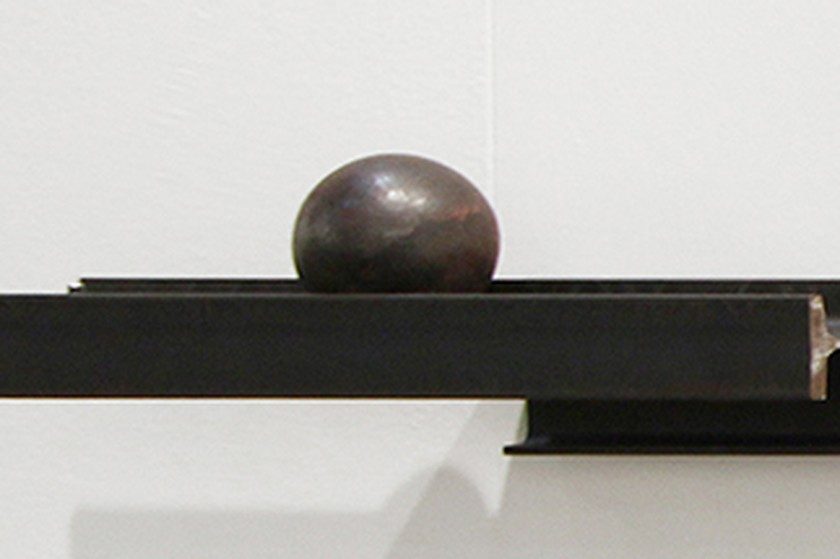
Eliseo Mattiacci
Eliseo Mattiacci was born at Cagli (Pesaro) in 1940. In 1964 he settled in Rome. His first solo exhibition dates from 1967: Mattiacci invaded the Galleria La Tartaruga in Rome with an articulated tube of nickel-plated iron, 150 metres long; modified in relation to the different settings, it was presented the same year in several shows, among them “Arte Povera e Imspazio” at the Galleria La Bertesca in Genoa, the exhibition curated by Germano Celant that marks the beginning of the story. In 1968 at L’Attico in Rome, Mattiacci showed works made with everyday objects or with manipulated industrial materials, which provoke unusual tactile experiences or visually heighten the force of gravity, weight, magnetism: Bilico, Cilindri deformati a elicoide, Pneumatici d’autotreno, Contrasti di peso, Calamita e trucioli. From 1968 the works of Mattiacci conceived in the terms of an action grow more frequent, and in some of them the spectator is drawn into the creative process. “Lavori in corso”, carried out at the Circo Massimo in Rome together with the pupils of the Istituto d’Arte, dates from that year. The enquiry into his own identity in relation to what is other than himself, the interest in cultures other than the Western one, the testing of the modes of communication, are the central themes of Mattiacci’s work through the 1970s. Taken as a whole, the room of his own at the XXXVI Venice Biennale in 1972, with the works Cultura mummificata, Alfabeti primari and Planisfero con fusi orari, represents a reflection on the various themes of communication and of the transmission of culture. While the 1975 exhibition at L’Attico, “Recupero di un mito”, is a homage to the culture of the American Indians, where the artist, in a series of photographs, takes on the likeness of the defeated people whose art and whose traditions have been broken. From the beginning of the 1980s Mattiacci’s work develops in the direction of what Bruno Corà has called “Opere spaziali-cosmiche-astronomiche”. More and more often Mattiacci takes on large dimensions, and in the course of the last decade he has made sculptures using sheets of Corten steel, cast-iron spheres and various iron elements. Marked on the surfaces are the courses of the planets, the ellipses of celestial trajectories, the concentric circles of the cosmic orders. He gives form to fragments of the infinite, traces trajectories between the Earth and remote destinations, builds machines that seem to pick up images from very far away. In his solo exhibitions the works become stations for interstellar communication, reflect celestial cosmogonies, capture the energies at work in space. So at the Castello Miramare in Trieste in 1987, at the XLIII Venice Biennale and at the Galleria Civica of Modena in 1988, at the Museo di Capodimonte in 1991, at the Galleria Dell’Oca of 1991, at the Fondazione Prada in Milan in 1993, at the Museo d’Arte Moderna of Bolzano and at the Centro per le Arti Visive of Pesaro in 1996, at the Mercati Traiani in Rome in 2001. The reference to cosmic space changes, intensifying, in the outdoor works, some of them permanently sited, others installed on the occasion of exhibitions.
Institutional exhibitions
Palazzo Ducale Museo di Capodimonte Castello di S. Giusto Palazzo Mazzancolli