Klaus Staudt
Klaus Staudt is born in 1932 in Otterndorf, Germany. During his medicine studies, he visits Documenta 2 (Kassel), where he is completely attracted by art world. Thus he decides to attend The Fine Arts Academy of Munich, having Ernst Geitlinger as a mentor and, together with Jürgen Morschell, they found Galerie Nota in 1960, and exhibit François Morellet, Otto Piene and Heinz Mack of ZERO group.
Staudt becomes one of the exponent of Concrete Art in Germany and, at the same time, he participates to avantgarde movement New Tendencies, founded in Yugoslavia in 1961. It has been influenced by Concrete Art, Kinetic Art and Op Art and its purpose is to stimulate a more active field of vision and interest the spectator in an auto-creative process.
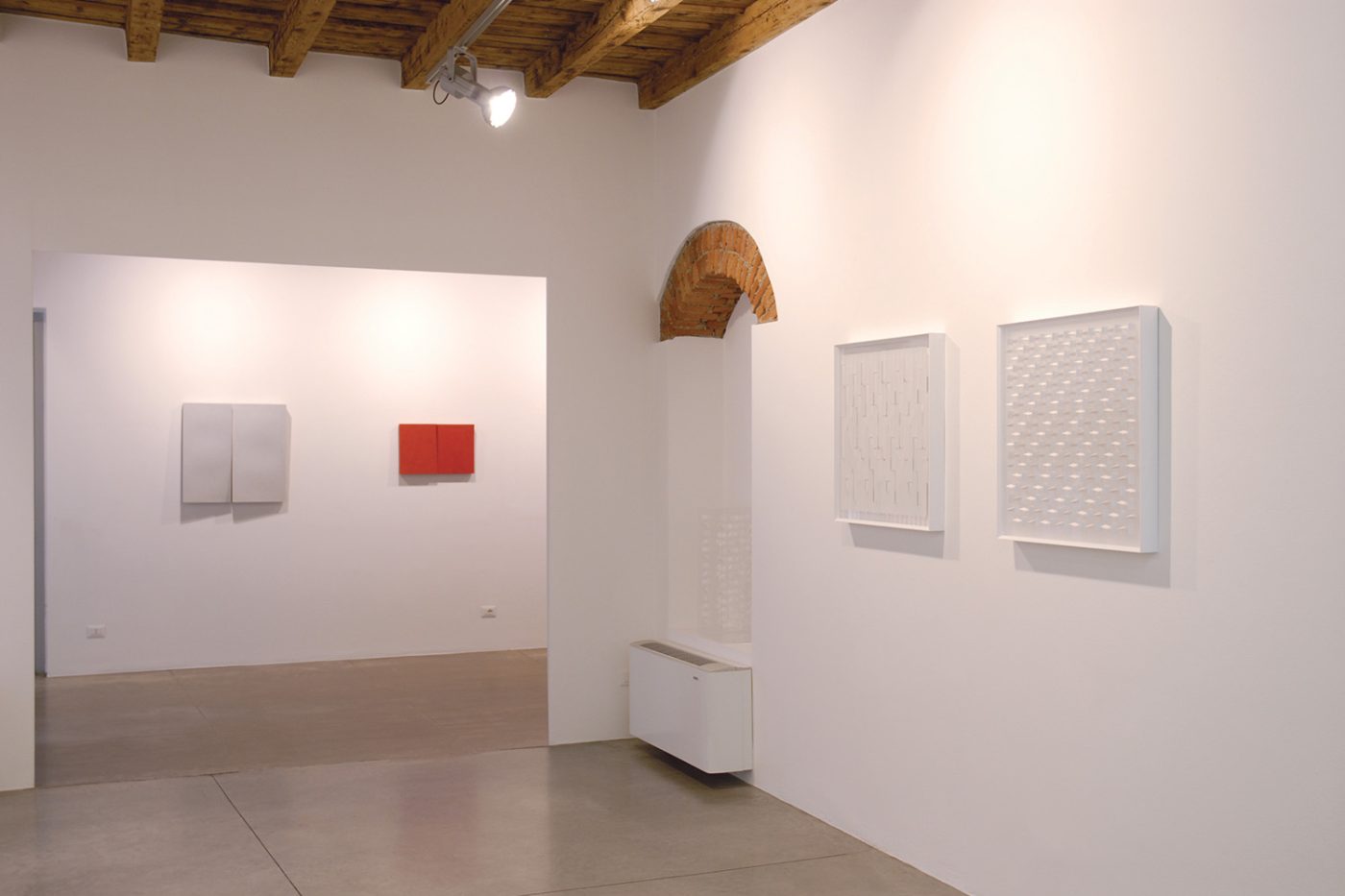
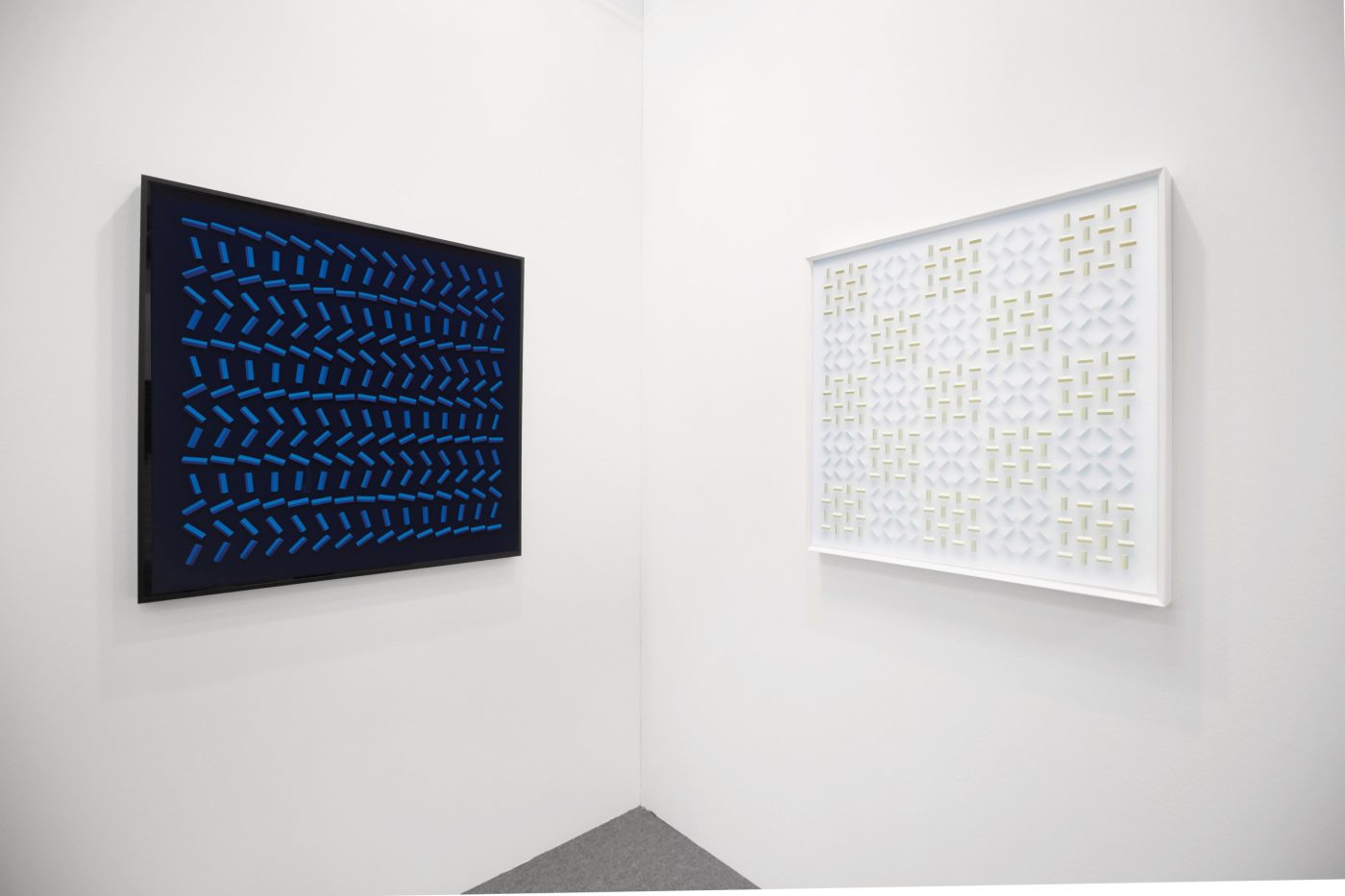
A process that, according to the german artist, must be rationally evident and just as comprehensible as its aesthetic result. It is precisely for this reason that Staudt’s notion of space – in all his works – is clearly marked by transparency. It is this transparency that underlies the importance he attaches to the field structure which, while being formed by identical individual relief elements within a series, may be arranged on different levels within the space of an individual work. A structured field formed from exactly identical elements may in its composition form mega signs that are either activated or concealed through the incidence of light, according to the spectator’s position.
A uniformly structured field undergoes a change in appearance when the viewer changes his position or when the angle of light incidence changes, creating the illusion of a virtual effect.
In Staudt’s works the relief is a development of what might be called three-dimensional pictures. The supporting growing is ordered by simple elements such as cubes, sheets or rods which, through repetition, form regularly arranged fields. By doing so, Staudt makes a connection with the traditional understanding of the relief, even if this involved modern, non-figurative means.
For Staudt, the use of color is conceivable only under the primacy of transparency. In some of his objects, the artist has used colored glass for the sheet that either completes the object or forms one of its various levels. Thus the viewer can look through the colored sheet of glass and still see the inner structure of the work in just the same way and to just the same extent as in the case of those works that are not colored. Here the color itself does not perform any aesthetic function within the structure of the object, indeed it could just as well be transparent white.
The dispute over color is one of the ongoing chapters of Concrete Art: for many artists color is not capable to be rationalized, in other words it is obsolete.
Institutional exhibitions
Leopold Hoesch Museum Museum im Kulturspeicher Museum Schauwerk Museo di Santa Giulia Museum Vasarely Grand Palais Kunstmuseum Wilhelm-Morgner-Haus Galerie im Museum Wilhelm-Morgner-Haus