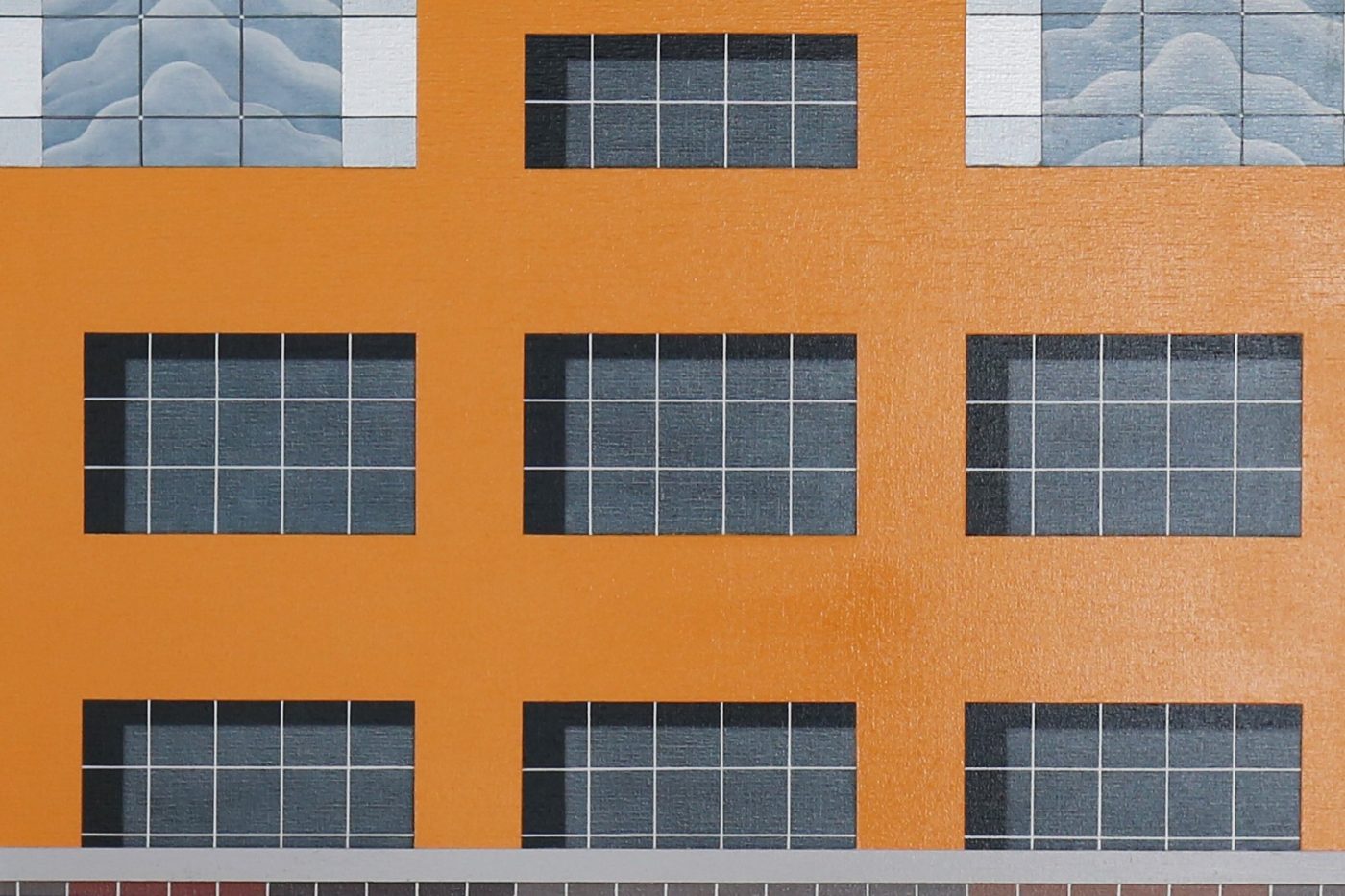
Enlightened Factory
- Artists
- Enzo Gagliardino
- Venue
- Galleria artesilva, via San Rocco 64/66, Seregno
Catalogue

Enlightened Factory
Curated by Valeria Dehò · artesilva, 2015 · 50 pages
Enlightened Factory
In un universo all’improvviso privato di illusionie di speranze, l’uomo si sente straniero. Questo esilio è senza via d’uscita perché privato dei ricordi di una patria perduta o dalla speranza di una terra promessa. Questo divorzio tra l’uomo e la sua vita, tra l’attore e la sua scena, è propriamente il sentimento dell’assurdità.
Albert Camus, Il mito di Sisifo
The history of man can always be traced back to the architectures he has managed to invent, to the enclosures he has built, to the organisation of social and living spaces. The work of Enzo Gagliardino speaks of these places, which are not to be confused with the non-places (non-lieu) of Marc Augè, which gather no identity, which are mutating landscapes, places bound up with transit, with transport or with mass leisure. In this case Gagliardino has dwelt on places strongly marked in anthropological terms, historical spaces, highly relational, with strong content. At the beginnings of his artistic activity these were the waiting rooms, the canteens, the gymnasiums, the hospitals in which the traces of the humanity passing through them are indelible. Buildings that have to do with architecture, but that are above all bound up with the daily life of people, with moments of a perhaps provisional exclusion from society, with suffering, with a communal life that is often enforced, and massified. After 1976 the centre of the artist’s attention shifted towards places of detention, the prisons, which never have the labyrinthine visionariness we learned from Piranesi, but are sad and gloomy places, without any imaginative projection. The painting of Enzo Gagliardino becomes harder and more bureaucratic still, it shows no sentimental lapses, it opens onto the tragedy of contemporary man but without tears and blood. It is a painting of silence, it partakes of the sadness of so many human situations as a contemporary form of meditatio on death and on the time that does not always pass as it should. It is also a cold painting without ever being detached, distant from what it represents, melancholy and lucid. Concentrationary spaces, asylums together with their complementary restraint beds, are symbols bound up with the culture of exclusion and of the protection of society against deviants, of every kind.
It is no accident, then, that the architectures of the 1980s appeared as a sort of liberation, of opening towards the outside, towards the landscape, urban though it be, peripheral, marked by long sequences of bricks condensed into factories and other non-places of production and of work. This is the phobic and repetitive universe of the painter, who has also, incredibly, found flashes of sky and cloud. And yet these traces of blue Gagliardino has shown not directly but obliquely, as chance emergences, unwanted, or else as reflections in the glass of the industrial buildings. Nature is an accident that sometimes disturbs the regularity and the gloom of the architectures; it is not autonomous but secondary, something not to be taken into account, which exists despite having been set aside and excluded from the human universe.
Enzo Gagliardino carries to its extreme consequence a painting that is precise and perfect without being hyperrealist and that never sinks into the smoothnesses of Pop. There is no eulogy of reality, so far are we from any demand for a realism that would be descriptive. The bricks take over the whole of the painted surfaces; the windows are false openings, both for their four-square opposition to the outside and because they become no more than corollaries of the wall, which remains absolute, elements of decoration whose function seems forgotten. Nor are there any reference points of street furniture, just as there are no pavements, street lamps and other “normal” things of the kind, parked cars, bus and underground stops, anything at all that might call up the human presence. The buildings, punctuated by the infinite and indefinite rhythm of the small brown bricks, are all there is. The wide windows are only consoling memories of a relation between inside and outside that can only be imagined and supposed. They have a function, but not a purpose. Gagliardino entrusts to painting, as he has always done, the idea that the logical construction of the world has already been carried out and that nothing is left to us but to look at the result. And this time painting is not consoling, it brings nothing on the plane of metaphor, of the symbolisation that sets art at a distance from reality. The quality of the painting is put at the service of a closed vision of the world, of an existential anguish that does not open even remotely onto the melancholy, alcoholic atmospheres of Eduard Hopper’s “Black Hawk”. The game is over and it is over for good, there are no other possibilities, no other openings. The only thing left for us to see is the wall, the wall, with the suspicion that nothing has remained either before it or beyond it. The dry, pitiless, definitive language of Enzo Gagliardino’s painting does not wish to add anything to what we know, nor does it wish to embroider on existentialism as a philosophy fairly demodé even if indispensable for understanding the twentieth century just past. We are not at tragedy, there are no dramas under way but the banal one of the sickness of existing. The very practice of painting, slow, precise, exhausting, makes it clear that the artist follows a rigorous and monastic discipline. The compulsion to repeat is a way of attuning himself to what he paints; there are no other universes, there are no shortcuts. The wall, the industrial building, is not a symbol bound up with the history of sociology, it is an absolute, as is Gagliardino’s choice of language. La Fabbrica illuminata (1964) by Luigi Nono is a memory of other times, other utopias. The consistency is total, the mirroring coincident; making, seeing, living are the same thing. Perhaps painting too is a religion, a falsely promised liberation.
The brick becomes the unit of measure of unhappiness, of an unsurpassable condition of being in the world, without alternatives and without hopes. To be and to live outside with a nostalgia for living shut inside a dwelling, and to stay indoors dreaming of the outside world. Probably a painting as obsessive as this has a sense precisely in its method, in its obliged, continuous direction: to repeat oneself is an attempt to lose and to forget oneself. One way of trying to understand the human condition passes through this interior search, and other analogous searches come to mind, other images that literature has made universal, from the desert of Dino Buzzati to the Stato d’assedio of Albert Camus, from the Castello of Kafka to the countless labyrinths of Jorge Louis Borges. The impossibility of finding solutions does not prevent one from going on looking for them, always, endlessly. We do not know whether or where the wall ends, nor even where it had its origin. Its existence is all that matters and all that has to be known.