Shaped Color
- Artists
- Domenico D’Oora
- Venue
- Galleria artesilva, via San Rocco 64/66, Seregno
Catalogue

Shaped Color
Curated by Giorgio Bonomi · artesilva, 2025
Shaped Color
DIFFERENCE AND REPETITION IN THE MONOCHROME OF DOMENICO D’OORA
by Giorgio Bonomi
The works of Domenico D’Oora are characterised, throughout their evolution, by remaining faithful to monochrome, without, for that matter, denying themselves developments and maturings, all of them rigorously within his underlying choice of language.
Monochrome in painting has a long history: we might have it begin from certain parts of paintings by Turner and then by Monet – who had seen the works of the English artist during his London stay – and arrive at Malević, who opens the way to absolute monochrome, then at “Color Field Painting”, as far as the more recent European Pittura Analitica.
D’Oora works out monochrome in an entirely personal way, avoiding the easy, and antiquated, use of a single colour. Thus, working on the surface and on the support, his poetics is articulated through constant and successive “slippages”, all of them within his stylistic foundations.
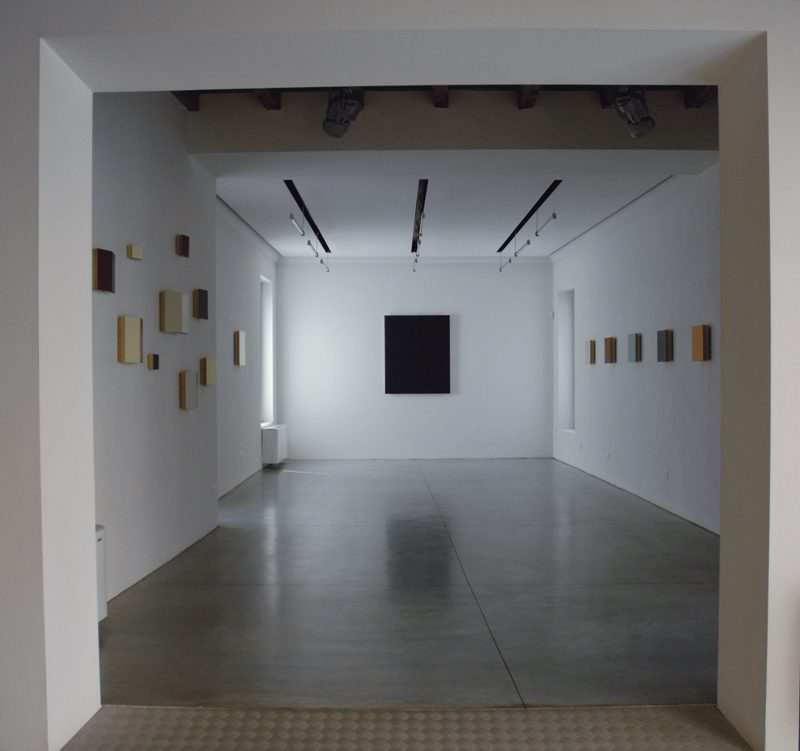
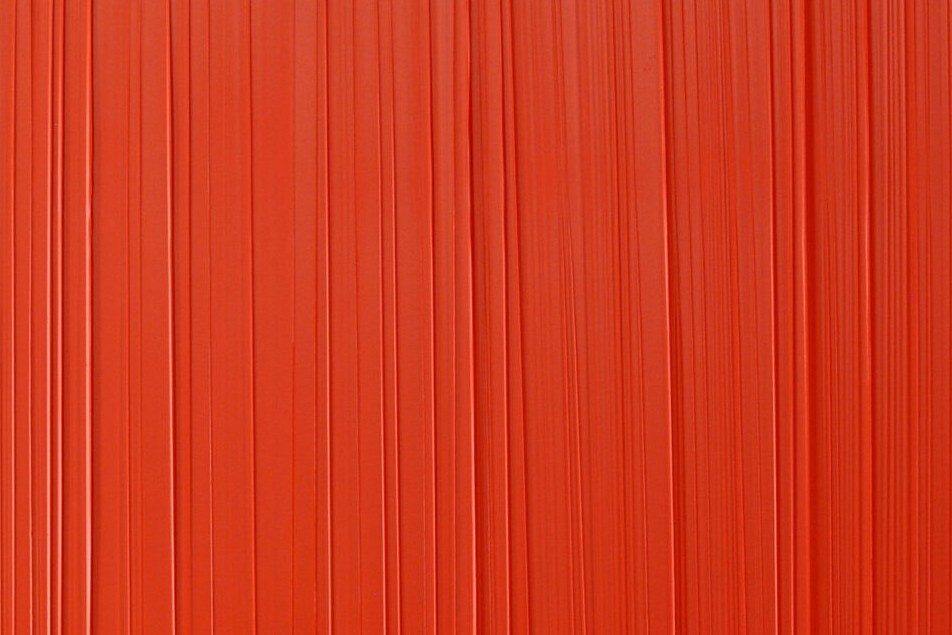
The works present here too are marked by certain differentiations with respect to the previous ones. Now, here, the rhythmic scansions of the material “lines” are all vertical and the supports are of aluminium.
D’Oora has always liked to make use of various materials (canvas, mdf, Plexiglas, slate and others) and to render the surface “agitated”, “rhythmic”, since the grooved lines produce lights and shadows, perceptual slidings, musicality. The “picture” for the artist is a complex totality, made up of the support, never “anonymous” or “contingent” but ontologically founded, and of the monochrome surface that is the phenomenal appearing of the work.
Our artist, just as he has “gone beyond” (in the Hegelian sense, which means “to remove and to preserve”) the rigidity of the “flat” use of a single colour, has likewise “gone beyond” the absolute, at times obsessive, prescription of Mondrian regarding the use of primary colours alone, and has equally avoided the formal “perfection” of much geometric abstraction, always leaving at the margins of the picture an “imperfection”, whether to indicate its “borders” or to mark the artistry (the handwork) of the making, setting himself apart from much “industrial” conceptualism.
For D’Oora the work, as we have suggested, is not limited to the frontal surface but has a thickness of its own, a “three-dimensionality”; we might consider it a kind of high relief, in its entirety and in the multiple reliefs of colour. Given these characteristics, it was natural for the artist to make sculptures properly in the round, obviously with surfaces like those of the pictures, almost as though these had “come down” from the wall to the ground.
D’Oora may be counted among those artists who answer to the Deleuzian concept of “repetition and difference” – such as, for example, Morandi, Fontana, Castellani – who certainly do not repeat the identical but proceed, in their continual enquiry, in the almost obsessive search for “perfection”, which they approach but, fortunately, do not reach, for otherwise they would cease to work and to furnish us with works of art.
D’Oora finds himself now in a situation of full maturity, which he lives without stopping at what has already been obtained but continues unceasingly to research and create, achieving results of great importance and presenting us with ever new works, such as those presented here.